The scene, to scale
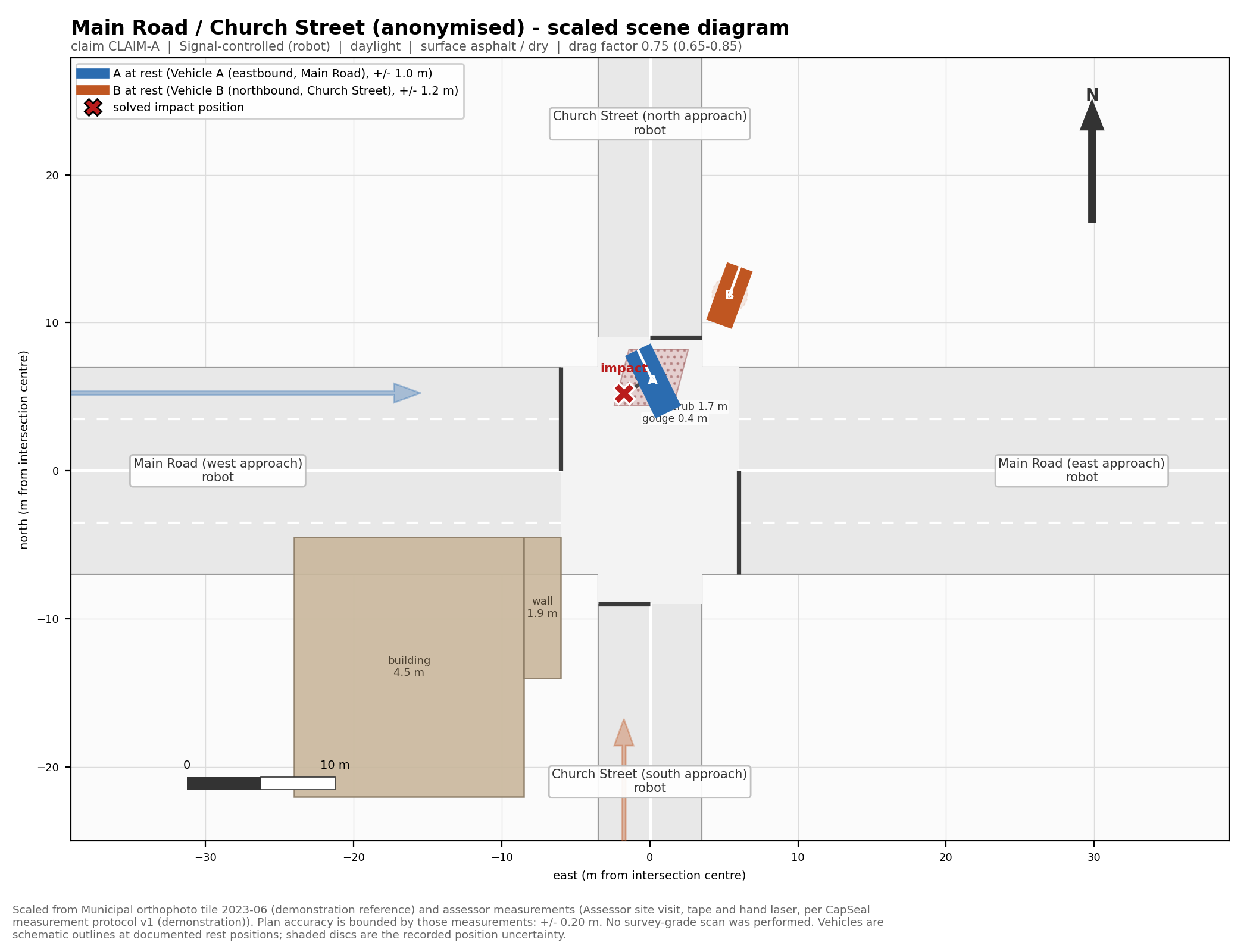
Between forensic reconstruction, which is defensible but uneconomic, and AI fault-split tools, which are cheap but collapse under cross-examination, there is nothing an insurer can put behind a mid-value disputed claim. This is a worked example of what sits in that gap: a sealed-evidence, physics-consistent, expert-signable reconstruction of a disputed intersection collision.
Two vehicles, a signal-controlled intersection, each driver asserting a green light, and a file that closed knock-for-knock at 50/50. The speeds below were not estimated. They are the speeds that put both vehicles where they were actually found.
Every input file hashed, RFC 3161 timestamped and logged with its origin in a hash-chained custody log. Files sealed at capture and files sealed on receipt carry different tiers, and the distinction is never blurred.
Intersection geometry, lane configuration, control type, sight lines, documented rest positions and road marks, with the measurement uncertainty stated rather than assumed.
Planar impulse-momentum impact solved against the documented rest positions, with every input, its source and the range it was swept across exposed so the analysis can be re-run independently.
Telematics and video aligned to the physics solution to establish entry order and time to impact. Where the evidence does not establish the order, it says so rather than choosing.
The consistent solution, then each party's own account played through the same physics. Where an account cannot produce the documented rest positions, the animation shows that failure and measures it on screen.
Structured as a Rule 36(9)(b) summary: assumptions, inputs, method, results, uncertainty, conclusion. Written for adoption and signature by an independent reconstruction expert, who remains the witness.
The value of a reconstruction is in what it refuses to claim as much as in what it establishes.